ERASMUS+ acaSTEMy Module 5 “Soft Skills for STEM Teachers,” is designed to enhance STEM teacher professional training by focusing on transversal competencies which are often called teachers soft skills. Part of the EU Teacher Academies initiative, acaSTEMy aims to create a systemic support structure for high-quality, research-based STEM education, integrating mobility and continuing professional development (CPD).
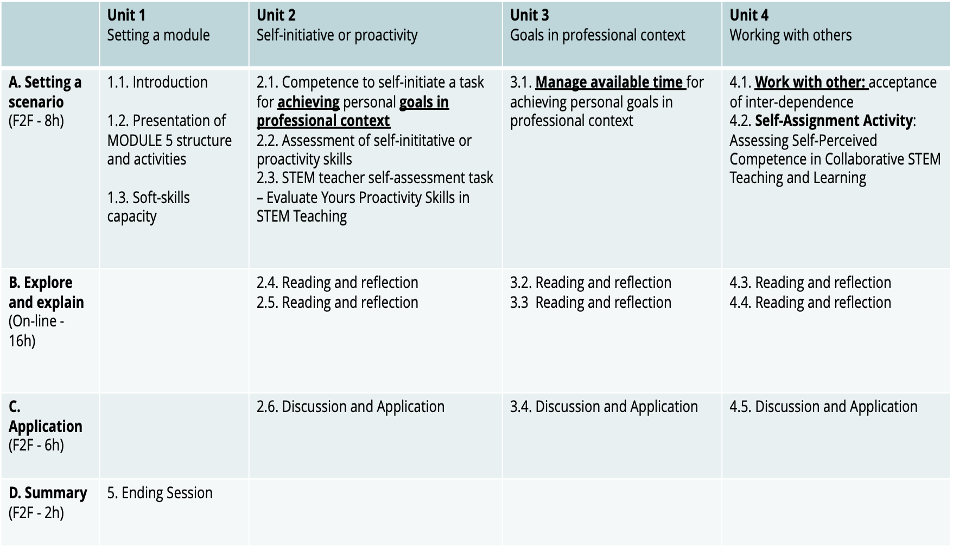
acaSTEMy Module 5 emphasizes soft skills consist of 4 units, and unit activities are divided among four targeted aims – A. Setting a scenario; B-Explore and explain; C-Application and D-Summary.
Unit 1 introduces concepts and importance of soft skills, which skills enable teachers to address diverse student needs, promote equity, and prepare students for STEM careers. Unit 2 focuses on self-initiative (proactivity), defined as proactively setting and pursuing goals without external prompting. Essential for STEM teachers, proactivity drives innovation, such as integrating digital tools or sustainability into curricula. In the Unit 2 is integrated a 60-minute self-assessment task uses SWOT analysis to evaluate proactivity in lesson planning, classroom management, and student engagement, followed by SMART goal-setting and a one-month follow-up reflection.
Unit 3 addresses managing professional time, analyzing STEM teacher workloads through various considered evidence. European STEM teachers allocate approximately 42% of their time to instruction, 19% to planning, 12% to administrative tasks, 7% to professional development, and 14% to non-teaching activities like extracurriculars. Therefore, challenges include time-intensive planning for inquiry-based lessons, administrative burdens, and limited PD opportunities, particularly in resource-constrained settings. Non-teaching duties, such as science clubs, further strain teachers schedules. Strategies to achieve professional goals include collaborative planning, digital tools, and reflective practices, are discussed.
Unit 4 explores collaboration, emphasizing interdependence in STEM teaching. Collaboration, distinct from cooperation’s task division, involves shared goals, such as co-designing interdisciplinary projects. Forms include intra- and interdisciplinary collaboration, professional learning communities (PLCs), teacher-industry partnerships, and digital platforms like eTwinning. Some recent studies indicates STEM teachers dedicate 5–10 hours weekly to collaborative tasks, but time constraints and training gaps are barriers. In the unit is integrated a 25-minute self-assessment activity evaluates competence across 10 collaboration categories (e.g., PLCs, co-teaching), with teachers rating confidence (1–5) and summarizing strengths and weaknesses. A 20-minute at-home action planning task sets SMART goals to improve collaboration, while a 30-minute group activity fosters experience-sharing and generates improvement ideas.
The “Explore and Explain” section includes a reading and reflections tasks.
Overall, Module 5 equips STEM teachers with soft skills to create inclusive, innovative classrooms, addressing global challenges like sustainability and digital transformation. By fostering proactivity, time management, and collaboration, it supports STEM teachers in navigating diverse educational demands. The module’s structured activities—self-assessments, goal-setting, and group discussions—promote reflective practice and professional growth, aligning with acaSTEMy’s vision of transversal, future-ready STEM education.
MODULE 5 structure and activities
- Opettaja
Anssi Salonen