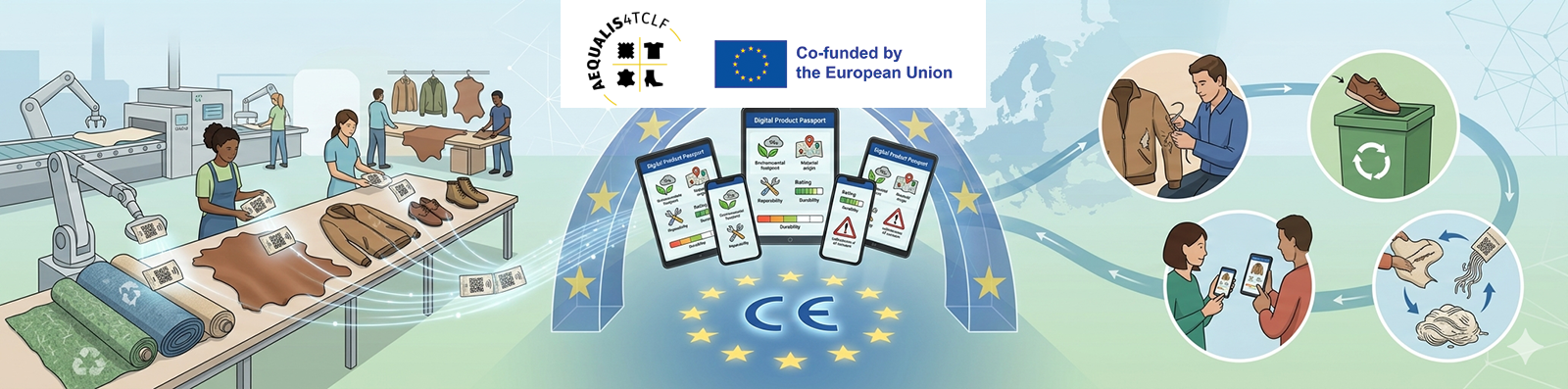
Micro-credential title: Digital product passport
Thematic pathway: Sustainability tools for assessing textile products
Part of module: Role of certification process in assessment of sustainability
EQF level: 7
ECTS credits: 2
Learning methods and duration: Approximately 50 hours (10 hours e-learning, 3 hours face-to-face, 34 hours work-based learning, 3 hours assesment)
Assessment methods:
- Initial assesment (quiz)
- Formative assessment (quizzes, group works and activities)
- Summative assessment (projects and assignments)
General objective: The learner will be introduced to:
-
Definition, historical overview and emergence of the Digital Product Passport (DPP) concept and key functionalities of DPP
-
DPP in the context of the circular economy; terms: CE (circular economy), EPR (extended producer responsibility)
-
The role of DPP in the transparency of the textile value chain; problems of tracking materials and components in textiles; content of DPP for textiles; overview of DPP in the textile value chain; example of data in DPP through the stages: raw material, production, distribution, use, recycling
-
Artificial intelligence (AI) and the Internet of Things (IoT) in supporting DPP; the role of RFID/NFC tags and QR codes and challenges of DPP implementation
Start and end dates: Currently not available
Responsible institution: University of Zagreb (Croatia)
Contact:
Learning outcomes
Knowledge
After the completion of this module/course, learners will:
• Describe the concept, evolution and key functionalities of the Digital Product Passport (DPP) and its relevance to sustainability and circular economy objectives.
• Explain the role of the DPP within the EU strategies for sustainable and circular textiles, including links to Extended Producer Responsibility (EPR) and environmental policies.
• Recognize the environmental significance of the textile sector and the role of the DPP in addressing textile waste, resource efficiency and circularity.
• Describe the structure and content of the Digital Product Passport (DPP) for textile and clothing products, including material composition, origin, chemicals used and end-of-life information.
• Explain the technological foundations supporting the implementation of the DPP, including AI, IoT, RFID/NFC, QR codes, hyperspectral imaging and blockchain.
Skills
After the completion of this module/course, learners will be able to:
• Apply relevant quality and environmental standards to evaluate textile products and processes in accordance with sustainability criteria.
• Analyze test data and certification requirements to assess environmental performance and product quality in textile systems.
• Use laboratory testing methods and conformity assessment procedures to support sustainable textile certification.
• Develop certification strategies for textile products and processes based on regulatory requirements and sustainability goals.
• Analyze the potential of digital tools, including blockchain and Digital Product Passports, to enhance transparency and traceability in textile certification.
Competences
After the completion of this module/course, learners will:
• Demonstrate independent judgement in selecting and applying appropriate certification and testing schemes for sustainable textile products.
• Manage quality certification and testing activities in collaboration with laboratories, certification bodies, and regulatory authorities.
• Support organizational decision-making related to sustainable product development, certification, and environmental compliance.
• Execute team-based case study analyses addressing sustainability-driven process and product certification challenges in the textile industry.