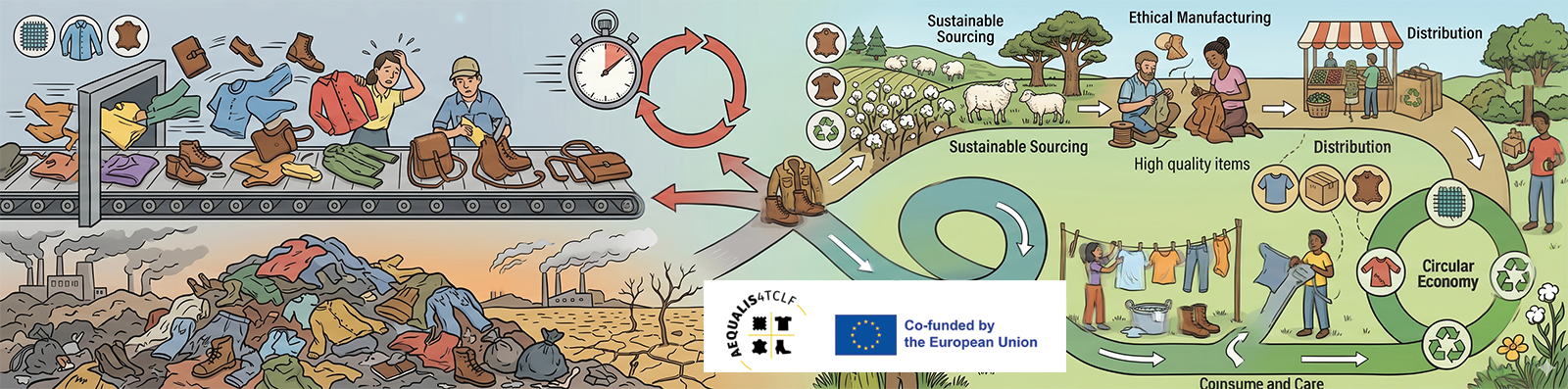
Micro-credential: Fast vs. slow fashion concept through holistic approach
Thematic pathway: Creating new products from old clothes
Part of module: Upcycling and Recycling in Fashion Design
EQF level: 4
ECTS credits: 1
Learning methods and duration: Approximately 25 hours (7 hours e-learning, 1 hours face-to-face, 15 hours work-based learning, 2 hours assessment)
Form of participation: Online learning
Assessment methods:
- Initial assesment (quiz)
- Formative assessment (quizzes, group works and activities)
- Summative assessment (projects and assignments)
General objective:
- The key differences between fast and slow fashion, including their environmental, social, and economic impacts.
- Core sustainability frameworks in fashion, such as the circular economy, the 5R principles, and the life cycle of a clothing product.
- Innovative and sustainable business approaches that promote responsible consumption and production in the fashion sector.
Timing: 1 Sept 2026 - 30 April 2027
Responsible institution: Klaipeda Technology Training Centre (Lithuania)
Contact person, email: Aurelija Bulciene, aurelija.bulciene@ktmc.lt
Learning outcomes
Knowledge
After the completion of this module, learners will:
- Understand the fundamental differences between fast and slow fashion and their environmental, social, and economic impacts.
- Describe key sustainability frameworks used in the fashion industry, including the circular economy, the 5R principles, and the life cycle of a clothing product.
- Recognize examples of sustainable business models and good industry practices that promote responsible production and consumption.
Skills
After the completion of this module, learners will be able to:
- Analyse the life cycle of a fashion product, identifying stages with the highest environmental impact and opportunities for improvement.
- Evaluate fashion brands or systems to identify unethical practices and sustainability gaps.
- Develop a basic sustainable business model or strategy that incorporates slow fashion principles and circular economy approaches.
Competences
After the completion of this module, learners will:
- Make informed judgments about sustainability challenges in the fashion sector and propose alternative solutions aligned with slow fashion principles.
- Apply sustainability concepts (5R, eco-design, circularity) to improve or assess fashion-related processes or products.
- Engage responsibly as a consumer or emerging professional, advocating for ethical, sustainable, and circular practices within the TCLF sector.
- Opettaja
Aurelija Bulciene